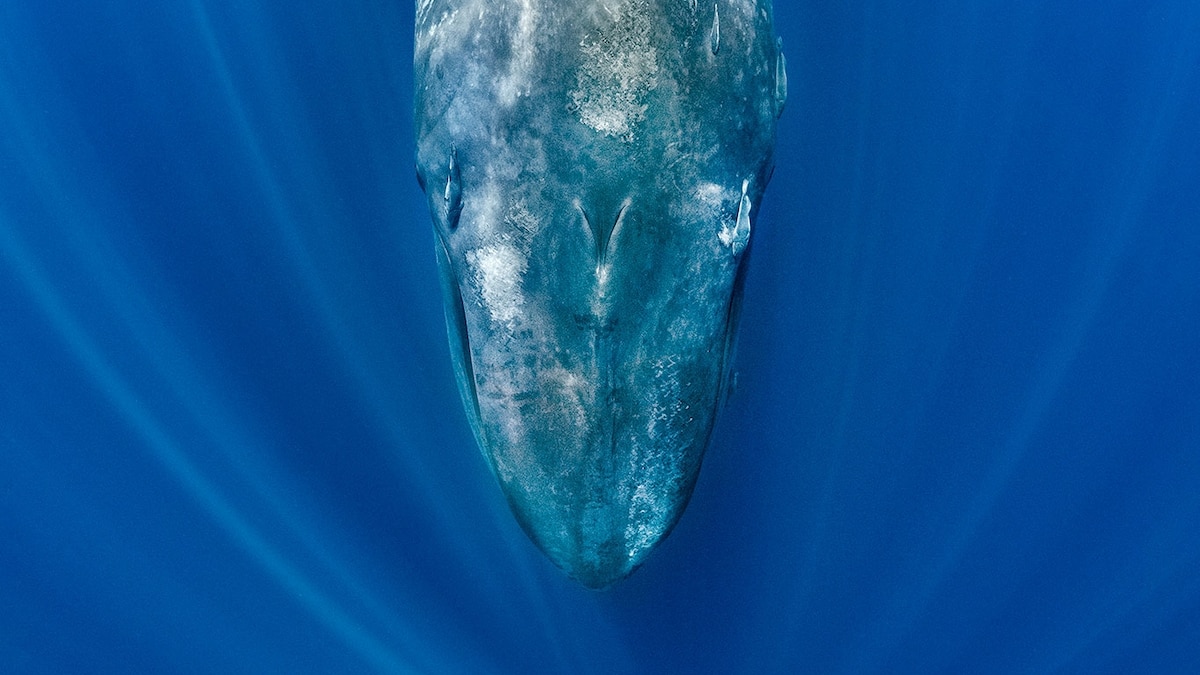
“We were interested in understanding blue whale ecology,” says Dawn Barlow, an ecologist at the Marine Mammal Institute at Oregon State University, and lead author of the study. “And without trying, we ended up studying the effects of marine heatwaves—which, in this day and age, is hard to avoid when working in the ocean.”
Using underwater recorders in the South Taranaki Bight, Barlow and her team tracked two distinct vocalizations: low-frequency D calls, linked to feeding, and patterned songs, associated with mating. During years of abnormally warm water, they found fewer D calls in spring and summer—signaling a drop in foraging effort. In the following fall, blue whale song intensity also declined, suggesting reduced reproductive activity.
“When there are fewer feeding opportunities, they put less effort into reproduction,” Barlow explains.
The absence of calls has become a warning, say scientists.
“Blue whales are sentinels,” says Barlow. “They integrate many ocean processes. Where they are, and what they’re doing can tell you a lot about the health of the ecosystem.”
And the effects of a single heat wave can last long after temperatures have cooled.
“The Blob really highlighted how long-term these consequences can be,” she adds. “This isn’t just about what happens during the heatwave—it’s the lasting impacts, especially for long-lived animals like whales.”
That longevity makes them powerful sentinels. If a species capable of roaming an entire coastline begins to falter—struggling to find food, delaying reproduction—researchers say the signal is unmistakable: something deep within the ecosystem is shifting. And in places where heat waves scorch areas again and again, the transformation may be irreversible, leaving behind a sea that is profoundly—and perhaps permanently—changed.
“There’s a chance that one of these events becomes a tipping point, and that may not return to the state we had before,” says Benoit-Bird. “And that matters. For how the ocean absorbs carbon, for the fish we eat, and for the future of marine ecosystems.”
Could listening to whales help protect the ocean?
Even shallow waters, where snapping shrimp crackle like underwater firecrackers, are beginning to sound different. A study published in 2022 found that shrimp, one of the ocean’s most active noisemakers, snapped more frequently and with more force as water temperatures increased. Possibly, the scientists speculate, because they’re agitated.
One challenge for using sound to measure ocean-wide changes is establishing a baseline for what a pristine ocean sounds like. The COVID-19 pandemic offered a rare experiment. When global shipping activity came to a halt, a brief hush settled over much of the planet, including the seas, before it was catapulted to even faster production.
“Certainly the animals responded—they changed their distribution and used the habitat differently when there weren’t humans in those spaces anymore,” says Monterey Bay’s Benoit-Bird.
She recalls the way that many witnessed wildlife in empty city streets. In the ocean, the reaction was just as profound, only harder to witness. “We don’t tend to think of humans as being in the ocean in that same way,” she adds, “but we are. We’re there—we’re everywhere.”
While scientists have recently detected certain patterns, more data is needed to connect specific sounds to specific environmental changes.
“It’s so hard to get observations in the ocean,” says NOAA’s Santora. “A network like this opens the door to so many possibilities—for conservation, for management, for mitigation.”