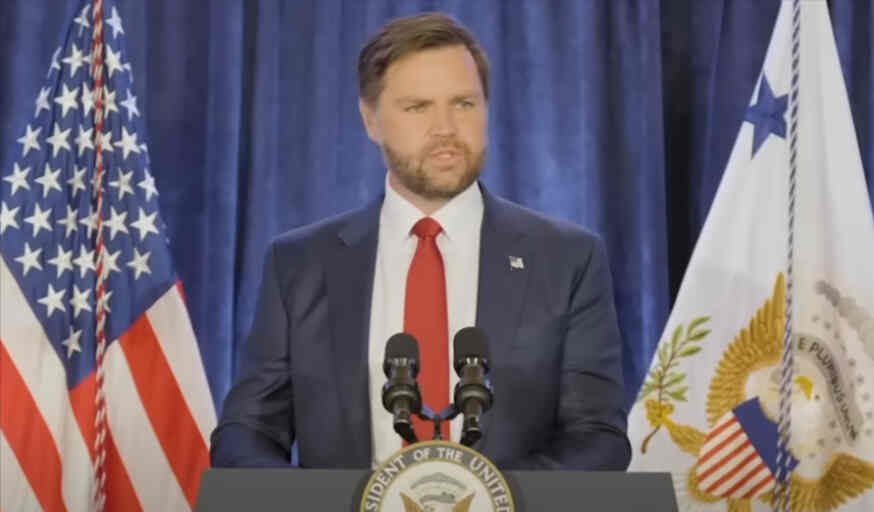
And finally, last but certainly not least, I have to thank my lovely wife for being here tonight, but for everything that she does for me and our family. I love you, honey. And I always joke with Usha that she’s my good barometer for whether I’ve said anything that’s a little bit too far out there. So I’ll hear about it afterwards. But unfortunately for all of you, strap yourselves in because I’ve got the microphone. I’m going to say whatever the hell I want to for the next 30 minutes.
The Question of Statesmanship in 2025
Now, I know the theme, of course, is about statesmanship and more to the point about how to respond to some of the challenges our movement will need to confront in the years to come. And this question of statesmanship is an interesting question because I think we have too few statesmen in the United States in 2025. It’s one of the things that are in very short supply.
I think it’s useful to reflect on where we are in the United States in this moment. In particular, before I talk about our positive vision and a particular theme that I care about, I think it’s worth reflecting on the American left in 2025 because if you’re anything like me, I was very optimistic that the left had had such a beating in the 2024 elections that they might have a come to Jesus moment. They might look around and say, you know, maybe the American people are not going to go for grown men beating up women in girls sports. Maybe the American people are not going to go for a wide open southern border that has allowed tens of millions of people to come into our country, undercutting the wages of American workers and, of course, making our society much less safe. Maybe the American left will realize that they have to change courses and change directions.
But I think that we’ve learned, if anything, over the last six months that Trump derangement syndrome, that incredibly terminal and dangerous disease, is perhaps more virulent than ever among the American Democrats in the midpoint of the first year of President Trump’s second term.
The New York Democratic Primary: A Case Study
Now, last week, as has become sort of the main political story over the last couple of weeks, a 33-year-old communist running an insurgent campaign beat a multimillion dollar established machine politician in the New York Democratic mayoral primary. Now, I don’t want to harp too much on a municipal election, but there were two interesting threads that I think came out of Mondani’s victory that I think are worth us understanding because they’re reflective of where the broader American left is at this moment in time.
The first is that it drives home just how much the voters in each of the respective parties have changed. If our victory, if President Trump’s victory in 2024 was rooted in a broad, working, and middle-class coalition, Mondani’s coalition is almost the inverse of that. If you look at his electoral performance precinct by precinct, what you see is a left that is completely left behind the broad middle of the United States of America.
This is a guy who won high-income and college-educated New Yorkers, and especially both young, highly-educated New Yorkers, but he was weakest among black voters and weakest among those without a college degree. That’s an interesting coalition. Maybe it works in the New York Democratic primary. I don’t think it works particularly well in the United States at large. He did particularly well in the Bangladeshi areas of New York, but he did particularly poorly with non-Bangladeshi Asian immigrants, particularly Chinese Americans.
And if you look at the precincts where he did the best, it was in New York’s gentrifying neighborhoods, places like Ridgewood and Bushwick, places I haven’t heard anything about, but I read about in a paper. His victory was the product of a lot of young people who live reasonably comfortable lives, but see that their elite degrees aren’t really delivering what they expected. And so their own prospects with all the college debt may not, in fact, be greater than those of their parents.
And I say that not to criticize them, because I think that we should care about all the people in our country, particularly those down-to-the-mobile, college-educated people who feel like the American dream is not quite all it’s cracked up to be. But we have to be honest about where his coalition is. It is not the downtrodden. It is not poor Americans. It is not about dispossession. It’s about elite disaffection and elite anger.
Identity Politics as a Political Tool
The party of highly educated but down-to-the-mobile elites, they comprise a highly energetic activist base. But it’s important because it’s not just the elites, the college-educated New Yorkers. That base was supplemented by carefully selected ethnic blocks carved out of the electorate using identity politics as the knife.
And that, by the way, I think explains Mamdani’s bizarre appeals to foreign politics intended to signal to one particular group of New Yorkers or another. Well, let’s ask ourselves, why is a mayoral candidate in our nation’s biggest city whining about banning Bibi Netanyahu, a country whose population is about the same size as that of New York, and threatening to arrest a foreign leader if he tries to come to New York City? Why is a New York mayoral candidate attacking Narendra Modi, the prime minister of India, as a war criminal? Why is he talking about globalizing the Intifada? In fact, what the hell does that even mean in Manhattan?
The Contradictions of the Modern Left
But what might seem like a contradiction makes a little bit of sense if you peel back the onion. Consider a movement that rails against the billionaire class, despite the fact that the billionaire class remains firmly in the corner of the modern left. A movement that idolizes foreign religions, even as it rejects the teachings of those faiths. It rails this new modern left against white people, even as many of its funders and its grassroots activists are privileged whites themselves.
Now, I may not speak for many of you, but I was once comforted by these contradictions within the modern left. How could privileged whites march around with a straight face, decrying white privilege? How could progressives pretend to love conservative Muslims, despite those Muslims’ views on gender and sexuality?
But the answer is obvious if you think about it. And it’s a very, very dangerous and very sad answer. The radicals of the far left, they don’t need a unifying ideology of what they’re for, because they know very well what they’re against. What unites Islamists, gender studies majors, socially liberal white urbanites, and big pharma lobbyists, it isn’t the ideas of Thomas Jefferson or even of Karl
The Hatred That Drives the American Far Left
Marx. It’s hatred. They hate the people in this room. They hate the President of the United States. And most of all, they hate the people who voted for that President of the United States in the last election in November. This is the animating principle of the American far left.
Now, to be clear, it isn’t true of most of the people who vote for Democrats. Most of the people who vote for Democrats, they’re good people struggling to get by, even if we think that they’re misguided in their political judgment. But pay close attention to what the leadership of this movement says outside of the glossy campaign ads and outside of the general election-tested messaging themes. And it’s obvious what animates the leadership of the modern Democratic Party.
The far left doesn’t care that BLM, the Black Lives Matter movement, led to a spike in violent crime in urban black neighborhoods, and it did, because that same movement also led to anarchy in middle class white neighborhoods. They do not care that Islamism hates gays and subjugates women, because for now, it’s a useful tool of death against Americans. And they don’t care that too many pharma companies are getting rich from experimental hormonal therapies, because in the process, they’re destroying the so-called gender binary that has structured social relations between the sexes for the whole of Western civilization.
And they certainly don’t care that deporting low-wage immigrants will raise the wages of the native-born, because they don’t mean to create higher living standards for those who are born and raised here, whether they’re black, white, or any other skin color. They mean to replace those people with people who will listen to their increasingly bizarre ethnic and religious appeals. They are arsonists, and they will make common cause with anyone willing to light the match.
And that’s why Mamdani himself is such an appealing instrument to the left. He captures so many of the movement’s apparent contradictions in a single human being, a guy who describes the Palestinian cause as central to his identity, yet holds views like abortion on demand or using taxpayer-funded money to fund transgender surgeries for minors. These views, of course, are completely incomprehensible on the streets of Gaza. This guy represents that contradiction. How can you believe in the cause of the intifada while also holding views that are completely anathema to those people? And the answer is because he’s not building a positive program. He’s not trying to build prosperity. He’s trying to tear something down. And he’s very effective at articulating all of the things that the far left hates in modern America.
The Call for Statesmanship: Being For Something
Now, Ryan and all of these incredible people asked me to speak on statesmanship. And I think one task of statesmanship is to recognize what the other side, what the far left wishes to do to America in 2025. But the most important part of statesmanship is to be for something. And I think that was what was so different about President Trump’s campaign compared to the 30 years of failed GOP politicians during my lifetime. It wasn’t just that he articulated what was bad. He wasn’t just articulating how the left had gone off the rails. He was also offering a positive vision that people could get behind. And that’s the second thread I want to touch on today.
Because if the left wishes to destroy, we must create. Not just over the next few years, but over the next generation. Now, the most obvious way to do that is to ensure that the people we serve have a better life in the country that their parents and grandparents built. And that’s the thing that makes me most proud of what the administration has done over the last six months.
Economic Nationalism: Tariffs and the One Big Beautiful Bill
Now, this is why the president cares so much about tariffs, a word that you weren’t allowed to say in polite American economic discourse even 20 years ago. But he recognizes that in a globalized economy, we must be willing to penalize those who would build outside of our own nation and who would use the workers of foreign countries over the workers of their own.
And it’s why he worked so hard over the last couple of months to pass the one big beautiful bill, which did pass. Because if tariffs are the stick, then lower taxes and regulations are the carrots. We want to make it easier to save and invest in the United States of America. We want to make it easier to build a business in the United States of America. But most of all, we want to make it easier to work a dignified job in the United States of America and build the kind of life and have the kind of wage that can support a family in comfort. That is our goal.
Beyond Material Concerns: The Crisis of Western Liberalism
But as you all know, I think as the Claremont Institute appreciates better than most, this is not a purely material question. Because we’re not just producers and consumers, we’re human beings made in the image of God, and we love our home not just because we earn a living here, but because we discover our purpose and our meaning here.
Every Western society, as I stand here today, has significant demographic and cultural problems. There is something about Western liberalism that seems almost suicidal, or at least socially parasitic, that tends to feed off of a healthy host until there’s nothing left. That’s why the demographic trends across the West are so bad, why so many young people, historically high numbers in all European countries, say that they would not die for their own country, because something about the liberal project in 2025 is just broken.
And I think what that is, is they’ve gotten awfully good at tearing things down, but they haven’t gotten good at building back. That’s what we have to do. America in 25 is more diverse than it has ever been. And yet, the institutions that take this incredibly diverse country and form culture are weaker than they have ever been. While our elites tell us that diversity is our greatest strength, they destroy the very institutions that allow us to thrive and build a common sense of purpose and meaning as Americans.
We are confronted with a society that is less than common than ever, and whose cultural leaders seem totally uninterested in fixing that. Just remember that four years ago, we had people promoting alternative national anthems at one of the few national remaining pastimes that transcended ethnic and cultural differences. They tried to take football away from us. It was like the last thing that was not political, and the left tried to take football away from us.
There are some Ohioans out there. Too many. We don’t want to take this too far. We’ve got to win Michigan in 26, guys. Not too much Buckeye love here.
Now, too many of our current crop of statesmen remain unable to break out of that moment, that crazy moment of a few years ago. They’re not as loud about it, but they’re still very much animated by its principles. Too many on the far left seem destined to erode the very thing that makes Americans put on a uniform and sacrifice their lives for our common nation.
Immigration and Social Cohesion
Now, part of the solution, I think the most important part of the solution, is you first got to stop the bleeding. And that’s why President Trump’s immigration policies are, I believe, the most important part of the successful first six months in the Oval Office. Social bonds form among people who have something in common. They share the same neighborhood. They share the same church. They send their kids to the same school. And what we’re doing is recognizing that if you stop importing millions of foreigners into the country, you allow that social cohesion to form naturally. It’s hard to become neighbors with your fellow citizens when your own government keeps on importing new neighbors every single year at a record number.
What Is an American? The Limits of Creedal Nationalism
But even so, if you were to ask yourself in 2025 what an American is, I hate to say it, very few of our leaders actually have a good answer. Is it purely agreement with the creedal principles of America? I know the Claremont Institute is dedicated to the founding vision of the United States of America. It’s a beautiful and wonderful founding vision, but it’s not enough by itself.
If you think about it, identifying America just with agreeing with the principles, let’s say, of the Declaration of Independence, that’s a definition that is way over-inclusive and under-inclusive at the same time. What do I mean by that? Well, first of all, it would include hundreds of millions, maybe billions of foreign citizens who agree with the principles of the Declaration of Independence. Must we admit all of them tomorrow? If you follow that logic of
America as a purely creedal nation, America purely as an idea, that is where it would lead you. But at the same time, that answer would also reject a lot of people that the ADL would label as domestic extremists. Even those very Americans had their ancestors fight in the Revolutionary War and the Civil War. And I happen to think that it’s absurd, and the modern left seems dedicated to doing this, to saying, you don’t belong in America unless you agree with progressive liberalism in 2025. I think the people whose ancestors fought in the Civil War have a hell of a lot more claim over America than the people who say they don’t belong.
So I believe one of the most pressing problems for us to face as statesmen is to redefine the meaning of American citizenship in the 21st century. I think we’ve got to do a better job at articulating exactly what that means. And I won’t pretend that I have a comprehensive answer for you, because I don’t. But there are a few things I’d suggest off the top of my head. And given that you guys are all brilliant intellectuals, I see Michael Anton back there. He’s the most brilliant. Given that you guys are all brilliant intellectuals, I think this is one of the main things that we need to run with over the next few years in our country. What does it mean to be an American in 2025?
American Citizenship Must Mean Sovereignty
For one, I think it has to mean sovereignty. More precisely, American citizenship must mean belonging to a nation that guards the sovereignty of its people, especially from a modern world that’s hell-bent on dissolving borders and differences in national character. I think that means having a government that vigorously defends the basic qualities of sovereignty, that secures the border from foreign invasion, that protects its citizens and their enterprises against unfair foreign tax schemes, that erects terror walls and similar barriers to protect its people’s industry, that avoids needlessly entangling them in prolonged distant wars.
It also means preserving the basic legal privileges of citizenship. Things like voting, including in state and local elections, or access to benefits like certain state-run health care programs for citizens. And if you pay attention, most of the howling about the big beautiful bill reduces to the fundamental fact that President Trump believes that Medicaid, Medicare and Social Security ought to go to the American people, not the illegal aliens who don’t have the right to be here. And when states, and of course we’re in one right now, start handing out these benefits to illegal aliens, they cheapen the very meaning of citizenship. And a nation that refuses to make that distinction will not stay a nation for very long.
Citizenship Means Building
I’d also say that citizenship in the 21st century necessarily means building. Because America is not just an idea, we’re a particular place with a particular people and a particular set of beliefs and way of life. Our ancestors realized that to carve a successful nation from new land meant creating new tangible things. New homes, new towns, new infrastructure to tame a wild continent. That is our heritage as Americans. That attitude enabled us to build the world’s greatest cities, its tallest skyscrapers, the most impressive dams and canals that the world had ever seen.
Over time, of course, it expanded the horizons of what we even thought possible as human beings. With Americans taking our species into the air and just a generation later into Earth’s orbit. Our innovations, American innovations, revolutionized communications, medicine, and agriculture, extending human lifespan decades at a time. And none of that would be possible if our citizens believed we lived in a post-industrial era. You can’t get to the moon on financial derivatives. You get to the moon on engineering and on building things.
We’re in an era where our finest minds just went to what are essentially speculative trades, order writing software that makes us more efficient consumers. Again, these can be important and honorable professions, but they’re not enough. And now in the 21st century is the time to build. We need to make great things here for the betterment of our fellow Americans, but also for our posterity. We need to continue to invent groundbreaking innovations and to leave homes and libraries and factories that our descendants will look at someday and feel a sense of awe.
And we need to build together as one American family. Getting to the moon required a lot of brilliant scientists working on what were effectively pocket calculators and slide rules. But it also required a national system of education that produced that level of genius, that fostered that level of genius, that inspired young graduates to look to the scars and want to go there on behalf of their nation. And it required a ton of very talented engineers and welders and custodians to manufacture the cutting-edge engines and to keep the facilities that housed them spotless.
It was a national project in the truest sense of the phrase. It had PhDs and people who didn’t graduate from high school. And I think to be a citizen in the 21st century must mean that we should be thinking about the future in similar ways and building similar projects as an American family. Citizenship should mean feeling pride in our heritage, of course, but it should also mean understanding milestones like the moon landings, not only as the products of the past national greatness, but as achievements we should surpass by aligning the goals and ambitions of Americans at all levels of society.
And by the way, when we went to the moon, when we built the great future of the post-war era, we did it with our fellow citizens. And we should reject, whether it’s Democrat politicians or corporate oligarchs, who say that we can only build the future by importing millions and millions of low-wage serfs. We can do it with American citizens, we’ve just got to have the will to actually try.
Obligations to Fellow Americans
Lastly, I’d say citizenship must mean recognizing the unique relationship, but also the obligations that we all share with our fellow Americans. You cannot swap 10 million people from anywhere else in the world and expect for America to remain unchanged. In the same way you can’t export the Constitution, the written words on a piece of paper, to some random country and expect the same kind of government to take hold. That’s not something to lament or be sad about, it’s something to take pride in. That this is a distinctive moment in time with a distinctive place and a distinctive people.
The founders of our country understood that perhaps better than anybody. They understood that our shared qualities, our heritage, our values, our manners and customs confer a special and indispensable advantage. I would say decisive one even, in rebellion against what was at the time the world’s greatest military power. That means something today. Citizenship, true citizenship, is not just about rights. In a world of globalized commerce and communication, it also is about obligations, including the obligations that we have to our fellow countrymen.
It’s about recognizing that your fellow citizens are not interchangeable cogs in the global economy, nor in law or commerce should they be treated that way. And I think it’s impossible to feel a sense of obligation to something without having gratitude for it. We should demand that our people, whether first or tenth generation Americans, have gratitude for this country.
I believe, and my own story is a testament to that, that yes, immigration can enrich the United States of America. My lovely wife is the daughter of immigrants to this country, and I am certainly better off, and I believe our whole country is better off for it. But we should expect everyone in our country, whether their ancestors were here before the Revolutionary War, or whether they arrived on our shores just a few short months ago, to feel a sense of gratitude. And we should be skeptical of anyone who lacks it, especially if they purport to lead this great country.
A Question of Gratitude
And that brings me back, finally, to the next likely mayor of New York. Today is July 5th, 2025, which means, as all of you know, that yesterday we celebrated the 249th anniversary of the birth of our nation. Now the person who wishes to lead our largest city had, according to multiple media reports, never once publicly mentioned America’s Independence Day in earnest. But when he did so this year, this is what he said, and this is an actual quote.
“America is beautiful, contradictory, unfinished. I am proud of our country even as we constantly strive to make it better.”
There is no gratitude in those words. No sense of owing something to this land and the people who turned its wilderness into the
Zoran Mamdani’s father fled Uganda when the tyrant Idi Amin decided to ethnically cleanse his nation’s Indian population. Mamdani’s family fled violent racial hatred only for him to come to this country, a country built by people he never knew, overflowing with generosity to his family, offering a haven from the kind of violent ethnic conflict that is commonplace in world history, but it is not commonplace here, and he dares on our 249th anniversary to congratulate it by paying homage to its incompleteness and to its, as he calls it, contradiction.
I wonder, has he ever read the letters from boy soldiers in the Union Army to parents and sweethearts that they’d never see again? Has he ever visited the gravesite of a loved one who gave their life to build the kind of society where his family can escape racial theft and racial violence? Has he ever looked in the mirror and recognized that he might not be alive were it not for the generosity of a country he dares to insult on its most sacred day? Who the hell does he think that he is?
A Family’s Fourth of July
Now yesterday I had different things to say on the 249th birthday of our nation, as I’m sure you’ve probably seen. But we had a great 4th of July in the Vance family. We took our three kids first to Mount Rushmore on July the 3rd, and then yesterday on the morning of July the 4th, we went to Teddy Roosevelt National Park in the Badlands of North Dakota, a beautiful area of our country.
We went hiking in the Badlands, which, we have an 8-year-old, a 5-year-old, a 3-year-old, can be dangerous work for parents of young children. They’re not as tough, maybe, as I hoped they were, but they did good, they did good. My 5-year-old so desperately wanted to see a buffalo, that’s what he talked about for weeks leading up to this trip, and in Teddy Roosevelt National Park I think he saw about a dozen of them. A very auspicious thing, my 8-year-old spotted a bald eagle perched on a low cliff on Independence Day, not a bad sign from the good Lord.
The Dandelion Moment
And my 3-year-old brought me a dandelion, and I’ll never forget this, it’s one of these moments that I think I’ll remember for the rest of my life. Now my 3-year-old brings me this dandelion, it’s a perfect dandelion, but her little lungs weren’t strong enough to send those dandelion seeds over the hillside, and so she asked me to do it. I remember watching her face light up as she watched those seeds blow over the hills.
I felt this profound sense of gratitude for this country. I felt gratitude for its natural beauty, for the settlers who carved a civilization out of the wilderness. I felt gratitude for making the love story of that little girl’s mother and father, me and my lovely wife Usha, possible. I felt gratitude for the common yet profound joy of watching a 3-year-old’s face, of watching her beautiful eyes light up as she watched those dandelion seeds dance in the wind against an ancient rock formation.
Our Home and Our Inheritance
This country is not a contradiction. It’s a nation of countless extraordinary people across many generations. It’s a land of profound ingenuity and tradition and beauty. But more importantly, it’s our home. For the vast bulk of Americans, it’s where we’re born, it’s where we will raise our children and grandchildren, and it’s where we ourselves will one day be laid to rest.
And when that day comes, I hope my kids can take solace knowing that their inheritance as Americans is not some unfinished or contradictory project, but it is their home, and it’s a home that’s provided them and their parents shelter and sustenance and endless amounts of love. But for them to know that, we must get to work.
God bless you. Thank you. Thank you. Thank you.