
Pack your bag—it’s time to dive into the dungeon!
What Is Satchel Quest?
Satchel Quest is a bag-building game for 1 to 4 players, ages 10 and up, and takes about 60 minutes to play. It’s currently seeking funding on Kickstarter, with a pledge level of $49 for a copy of the standard game, or $69 for the deluxe edition that has some upgraded components (but is otherwise the same gameplay). Satchel Quest has animal adventurers exploring dungeons, so there are monsters to fight, but nothing inappropriate or too scary for younger kids.
Satchel Quest was designed by Molly Johnson, Robert Melvin, and Shawn Stankewich and published by Weird City Games, with illustrations by Vincent Dutrait.
New to Kickstarter? Check out our crowdfunding primer.
Satchel Quest Components
Note: My review is based on a prototype copy, so it is subject to change and may not reflect final component quality. For instance, there is some artwork that is still in progress, and the bags will be slightly larger and match the player colors better.
Here’s what comes in the box:
- Village board
- 4 Hero boards
- 4 Skill Reference sheets
- 4 Starting Skill tokens (1 per hero)
- 48 Level Up Skill tokens (12 per hero)
- 4 Health trackers
- 4 XP trackers
- 4 VP tokens
- 4 Hero meeples
- 4 Satchels
- Start Player token
- 16 Dungeon Entrance maps
- 12 Dungeon Depths maps
- 21 Path cards
- 40 Tier 1 chips
- 25 Tier 2 chips
- 15 Tier 3 chips
- 45 Tool tokens (in 3 types)
- Gold tokens (in 1, 5, and 20 denominations)
Kickstarter backers will also get an exclusive adventure pack that includes 5 more path cards that won’t be included in the retail edition.
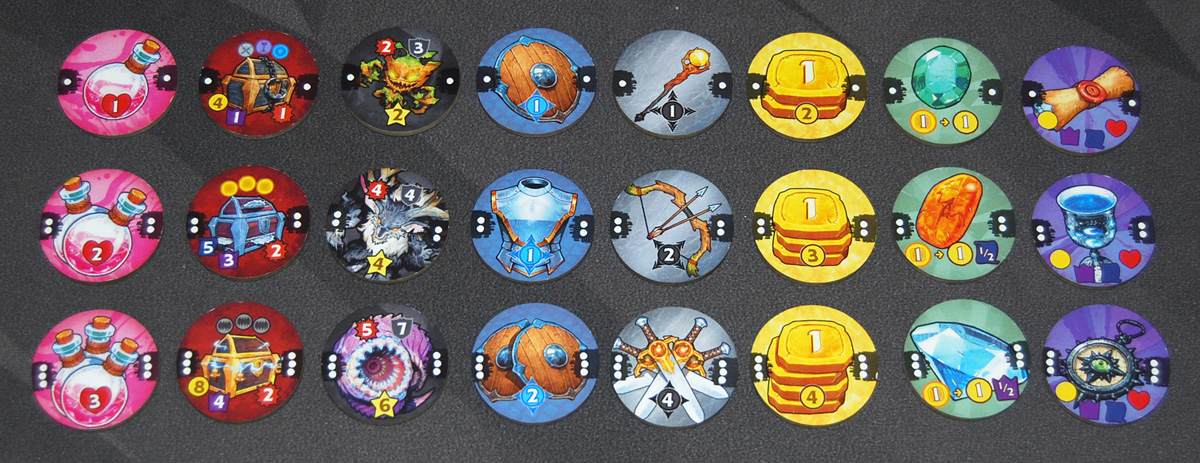
All of the chips in Satchel Quest are double-sided, with different items on each side. The chips in the standard edition will be cardboard, and the deluxe edition will use wood. Each of the chip types—potions, weapons, monsters, and more—have various icons indicating their strength, as well as 1 to 3 pips marking the chip’s level. (Starting chips have your character’s icon; I noticed that the wizard’s starburst icon was hard to distinguish from the single dot at a glance.) One issue we ran into with the prototype was that it could be hard to distinguish the XP icon (dark blue scroll) from the VP icon (purple crown) because they’re both roughly rectangular and darker colored—hopefully these will be a little more visible in the finished game. The small icons used for the chests could also be a little difficult to read, but there’s only so much room on the chip for the artwork and all the relevant icons.

Speaking of the artwork, Vincent Dutrait’s illustrations are impressive as always. The adventurers are all animals: a pangolin fighter, a dodo alchemist, a ram wizard, and a fox rogue. Dutrait’s depictions are very fun and give them a lot of personality. (I just wish the rogue and the fighter were a little more visible on the box cover!) The village board, with four animal merchants displaying their wares, makes a nice centerpiece.
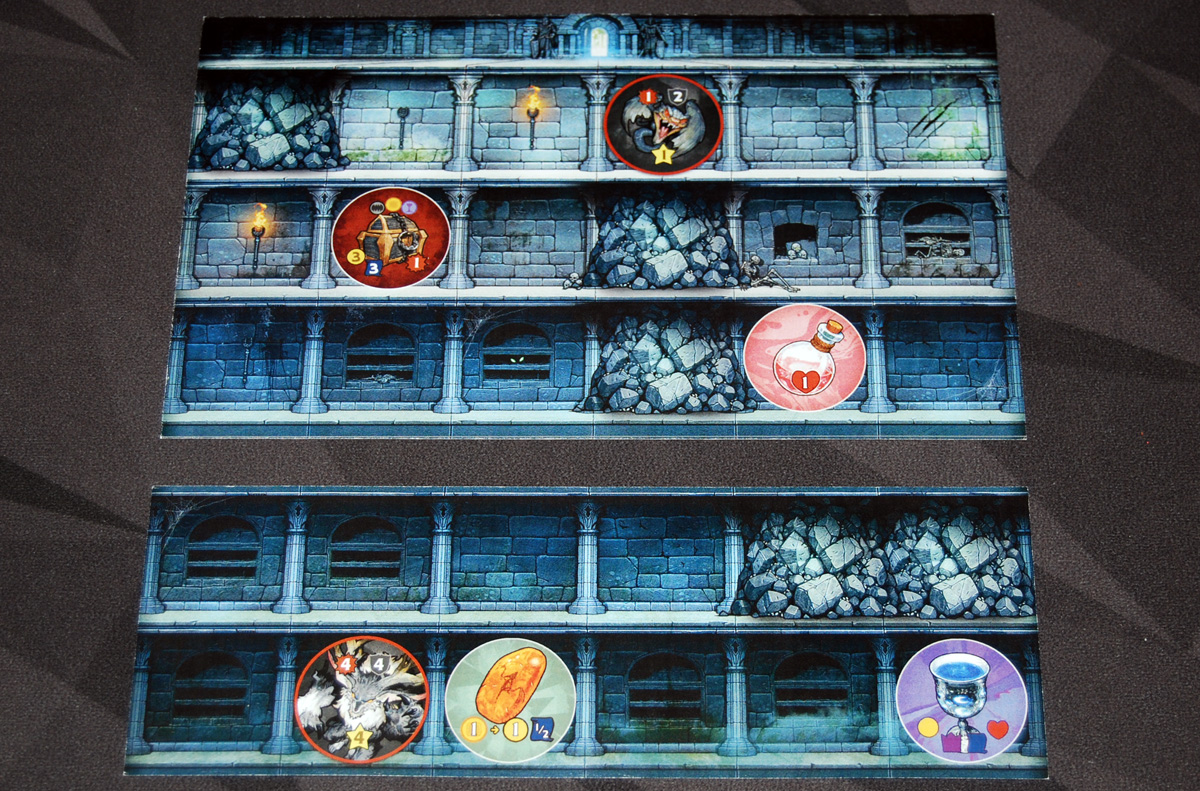
The dungeon maps are cardstock grids, though dressed up with more of Dutrait’s art: there are some chips printed on each map, along with some obstacles in the form of a heap of rocks. Each of the maps is double-sided, with different configurations on each side.
How to Play Satchel Quest
You can download a copy of the rulebook here.
The Goal
The goal of the game is to score the most valor points (VP) over the course of 5 dungeons.
Setup
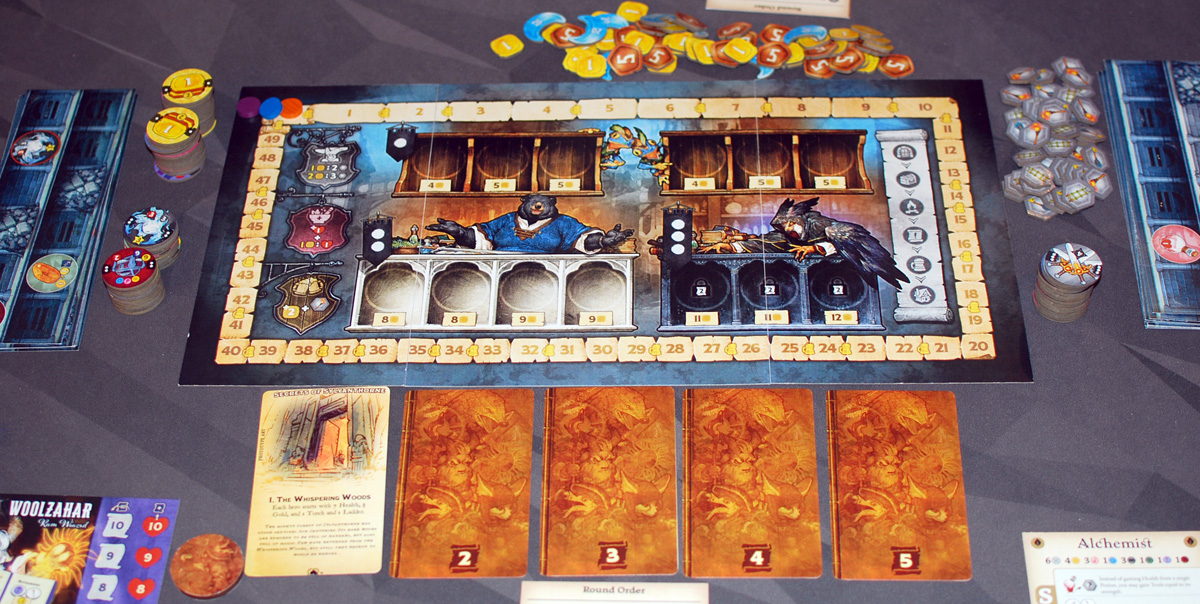
Place the village board in the center of the playing area. Make stacks of the Level 1, 2, and 3 chips nearby. Place the tools and coins nearby to form the supply. Shuffle the dungeon entrances and dungeon depths and make a stack of each. Choose a starting player at random.
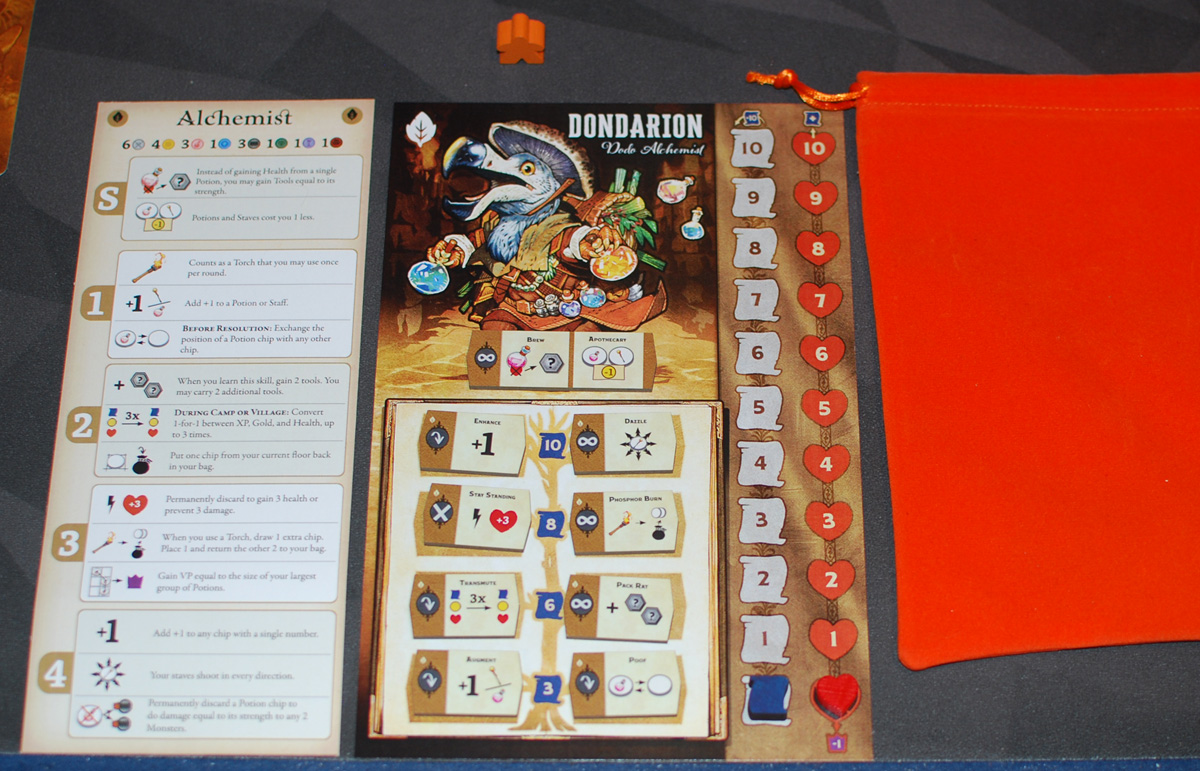
Each player takes a hero board and the matching components: 10 starting chips, XP marker, health marker, VP marker, meeple, bag, and skill tokens. Place your chips in your bag, and place your VP marker on the “0” space on the main board. Place your health and XP markers at the “0” spaces on your hero board. Place your hero’s starting skill token above your board. Turn the numbered skill tokens face down, randomly select two of each value, and place those on the skill tree on your player board, and then turn them face-up. The rest are returned to the box.
Choose an adventure path—each one consists of 5 cards, which are numbered. Place the the cards face-down in a row in numerical order. Reveal the first card, which tells everyone how much health, gold, and tools to start with.
Gameplay
Each round, players will explore a dungeon by drawing chips from their bags and placing them into their own dungeon maps, and then return to the village to level up and visit the shops.
When drawing dungeon maps, take from the bottom of the stack, and choose which side you would like to use.
Dungeon Phase
Each player draws a dungeon entrance map, and places their meeple next to the top row, which is the entrance floor. Everyone plays simultaneously. Draw a chip from your bag, and place it any available location in your current floor, with either side face-up. Pre-printed chips on your map have either a white or red outline: white outlines are optional and you may place your own chips over them, but red outlines are mandatory and may not be covered. Obstacles (rocks) also prevent you from placing chips.
When you fill a floor, you must decide whether to descend or stop. If you descend, you move your meeple down to the next floor and then continue drawing and placing chips. If you finish an entire map, you draw a dungeon depths map and add it to the bottom—you may shift it one space left or right if desired.

During the dungeon phase, you may use tools:
- Torch: Set aside the chip you just drew, draw a new one to place, and then put the set-aside chip back into your bag.
- Ladder: After drawing a chip, spend a ladder to move your meeple down a floor before it’s filled, and place the chip into your new floor.
- Key: During resolution, you may use a key to fulfill one requirement on a chest. (Maximum 1 key per chest.)
The dungeon phase ends when all players have decided to stop or have run out of chips. Any pre-printed chips on floors below your meeple’s location do not have any effect because you didn’t encounter them.
Resolution Phase
First, check the current Path card to see if there are any special instructions. Then, everyone resolves their dungeon in the following order: Potions, Chests, Monsters, Coins, Gems, Artifacts.
Potions: Gain 1 health for each potion on your map.
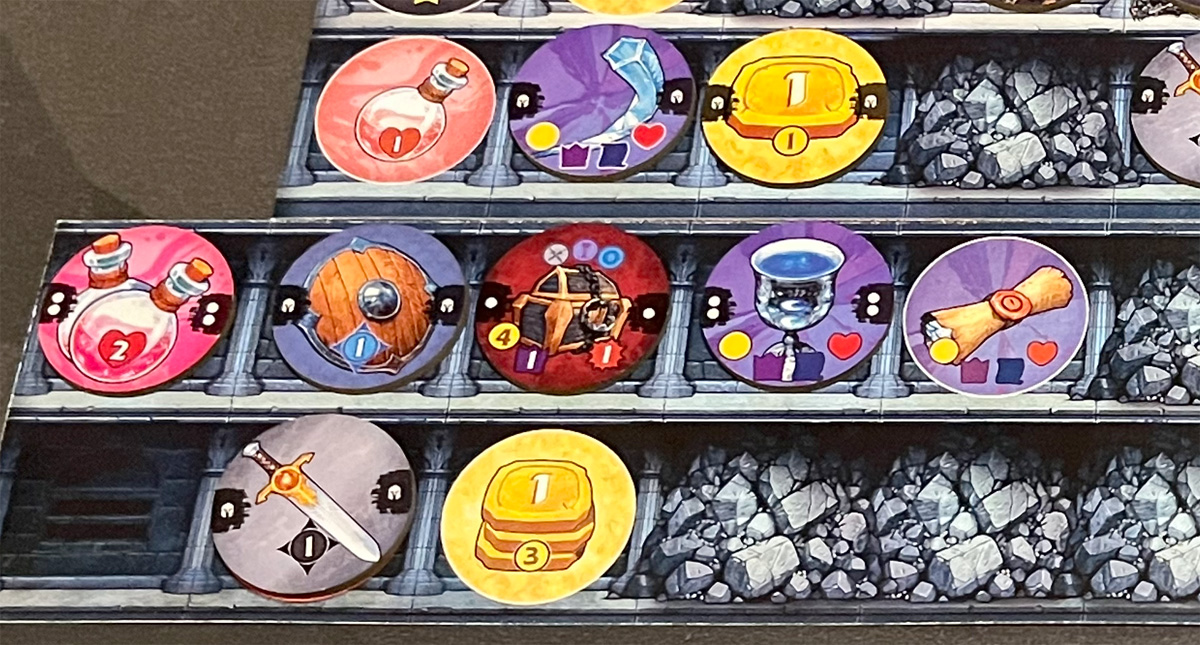
Chests: Each chest has a number of icons printed above it—these are the chips required to unlock the chest and gain its reward. The chips must be placed in any spaces adjacent to the chest (orthogonally or diagonally). If you place exactly the required chips, you will gain the reward and disarm the traps. If you place fewer than the required chips, you take damage and don’t get the reward. If you place more than the required chips, you gain the reward but you still take damage.
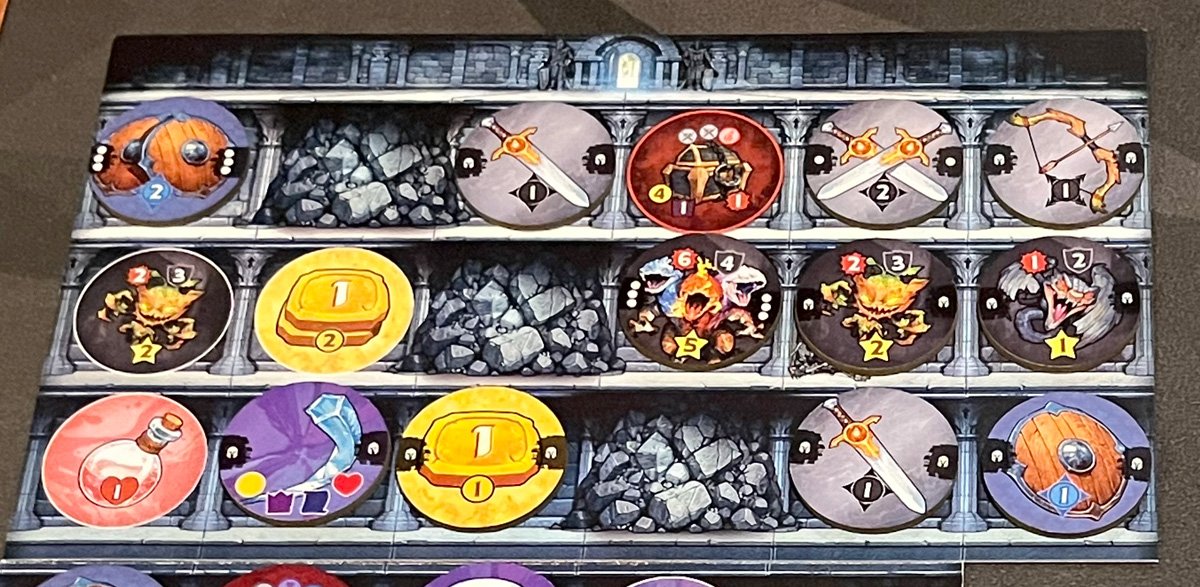
Monsters: The monsters get to attack you first! Each monster on your map does damage to you. Shields reduce damage from monsters that they’re orthogonally adjacent to, and armor reduces damage in orthogonal straight lines. If you run out of health, you have died (sorry) and will score half points for the rest of the round. If you take damage when you are at 0 health, you lose 1 VP per damage instead.
After taking damage from the monsters, you fight back! Each monster has a shield value, and if you do that amount of damage (or more) then you kill the monster and gain a reward. Swords attack all monsters orthogonally adjacent to them. Bows hit everything in all four diagonal directions at any distance (but are stopped by obstacles). Staves hit everything in all four orthogonal directions at any distance (but are stopped by obstacles). Each monster has a reward value shown in a star—you get that value in each of coins, XP, and VP.
Coins: Take gold equal to the value of the coins in your dungeon. Note that the coin chips can be worth up to 4 gold, even though the illustration has a large “1” on it because they show stacks of 1-value coins.
Gems: Gems give rewards based on the value of coin tokens surrounding them—all of them award coins, but some award XP or VP as well.
Artifacts: Check the size of each connected group of artifacts, as well as the number of different illustrations in each group, which is its “power.” The size determines the amount of the reward, and the power determines how many different rewards you may choose, from gold, VP, XP, and health. (In the photo above with the chest example, there is a size 3 group with 3 different illustrations, so the player can gain 3 each of 3 of the reward types.)
Camp Phase
During the camp phase, put all your chips back into your bag and return the dungeon maps to the tops of the stacks. Players who died are resurrected with 5 health, and players who have enough XP may level up. Once-per-dungeon skills are refreshed.
You must level up from the bottom of your skill tree, paying the XP amount shown to unlock a skill. You may only choose one of the two skills at each level (and then flip the other one face-down). Skills may be ongoing (infinity icon), once-per-dungeon (arrow icon), or once-per-game (X icon).

Path Phase
Reveal the next Path card and follow the instructions. (If there aren’t any more, the game ends.)
Tavern Phase
Count the number of mugs on the score track between you and the first place player. For each mug, you may gain 1 health or 2 coins.
Village Phase
Fill all of the shops with the appropriate level chips. Note that the Level 3 store is not stocked until round 2.
Beginning with the starting player, everyone will get to take turns in the village until everyone has taken 3 turns.
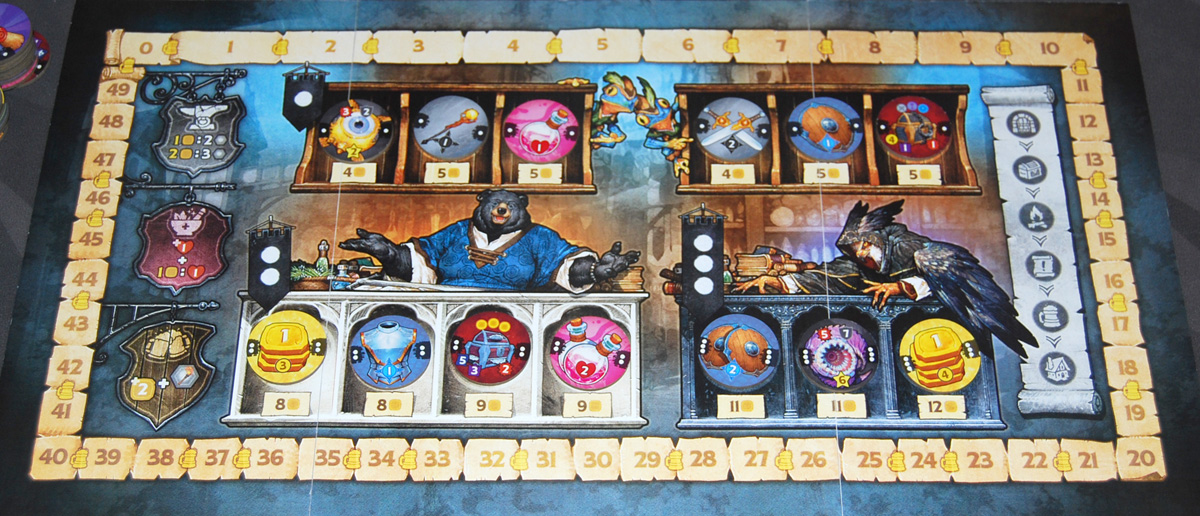
On your turn, you may first browse, and then shop. There are two options for browsing: peek at a chip and then return it, either side up; or spend a tool to refresh a shop (discard all chips and refill from the supply).
Then you may buy 1 chip or go to a specialty shop. The price for each chip is printed below its space; in addition, each hero gets discounts on particular chips, so if the right type is visible, you may buy it for less. Each shop only refills when the last chip in the shop is purchased.
There are three specialty shops:
- Gurdy’s Gear: spend 1 gold for 2 gears or 2 gold for 3 gear; you may hold a maximum of 3 gear.
- Healer’s Hut: gain 1 health; you may spend 1 coin for 1 health (but only once).
- Pterry’s Tavern: gain 2 gold and 1 torch.
After everyone has taken 3 village turns, the village phase ends. Pass the starting player marker clockwise, and start a new dungeon phase!
Game End
The game ends at the end of five dungeon phases.
Gain 3 VP for each skill you’ve unlocked.
Add up your total health, XP, and gold, and divide by 5 (round down). Gain that much VP.
The player with the most VP wins, with ties going to the player with the most gold.
Why You Should Play Satchel Quest
Longtime readers may know that I love deck-building games, and bag-building games have a lot in common. You start with a basic set of cards or chips, and you acquire more powerful cards/chips over the course of the game so that you can do more of whatever it is that you’re doing. I haven’t played quite as many bag-building games, but Satchel Quest does have some similarities to another favorite, Quacks of Quedlinburg (which also happens to be our 2019 Game of the Year). Draw chips from a bag, earn money to buy better chips, but also try to figure out the best way to score points.
One of the big differences, though, is the double-sided chips in Satchel Quest. It’s not really a press-your-luck game in the sense that you need to know when to stop drawing chips or you’ll bust. Instead, it’s a little more of a position-based puzzle—chips need to be grouped in particular ways to earn rewards and avoid damage, so your goal is to figure out what combination of chips (and tools!) will serve you the best. Every chip has two different types on the front and back, so if you draw a monster that you don’t think you can defeat, then you can always flip to the other side. The only thing akin to “busting” is if you overshoot the requirements on a chest, because you have to place every chip you draw, and if the only location left is next to a chest, you could wind up drawing the wrong thing and tripping a trap that would otherwise have been disarmed.
The other consequence of the double-sided chips is that—at least for me—it is a lot harder to remember what you have left in your bag. You might know that you have 8 weapons total … but is one of them that face-down coin that you placed two floors ago? Do you have enough shields to survive one more monster token? There’s a bit of a memory element to it, but I have to admit I end up guessing a lot … sometimes incorrectly.
The order of resolution leads to another puzzle. You drink all of the potions first and your health maxes out at 10, and then you face all of the damage from chests and monsters. That means you can’t just rely on an overage of potions—if the monsters are doing a total of 10 damage or more, then you’re going to die regardless of how many potions you have unless you can prevent the damage using shields or armor. Dying isn’t the end of the world—you get 5 more health afterward—but it does halve the VP you would earn that round. Like Quacks, that’s not so terrible early in the game when you might be earning only a handful of points, but later in the game when things ramp up, that can be very costly indeed. Monsters have some of the best rewards since they give you coins, XP, and VP all at once—but you have to figure out how to survive.
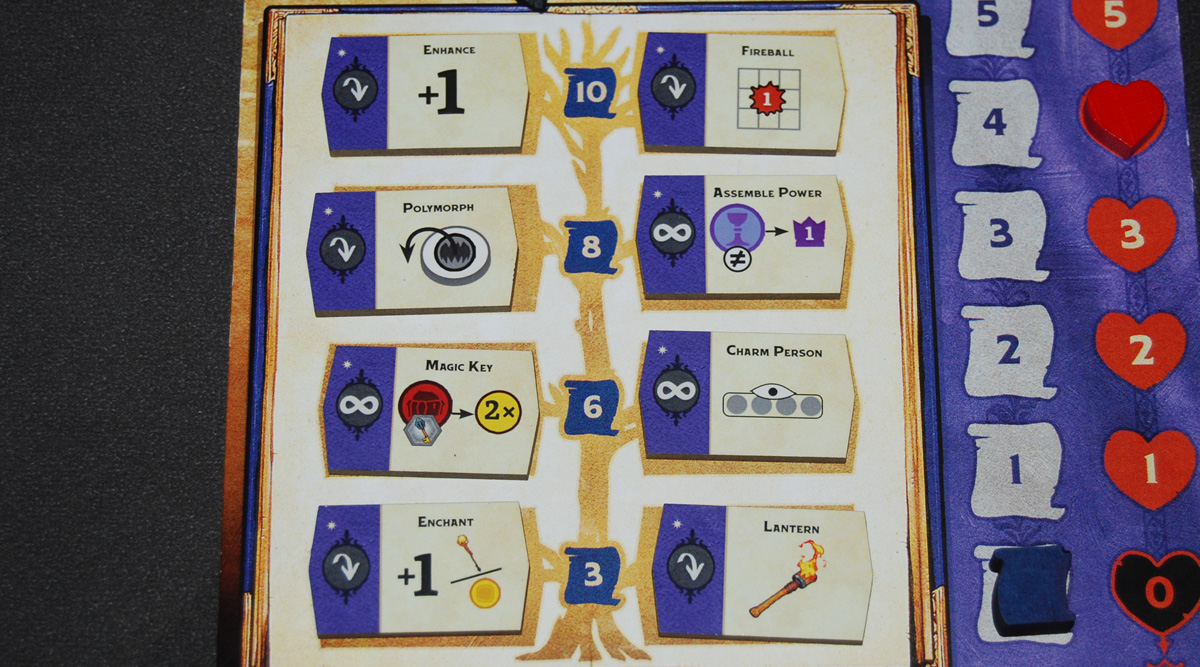
The skills are a lot of fun and are what give each hero a slightly different feel, plus each hero has two extra items on their chips compared to the other players. For instance, the fighter has one more sword and shield, while the alchemist has an extra potion and staff. Each time you play, you’ll have a random set of 8 of the 12 possible level up skills, which means even playing the same character twice may feel a little different depending on the mix you get. While there are a couple of common skills that everyone might draw, I particularly like the ones that are specific to the characters. The wizard’s Polymorph lets you flip one monster chip over before resolving. The rogue’s Hide in Shadows lets you put one chip on an obstacle space, even on a previous floor. Figuring out how to make the most of your skill set is important, and selecting skills that work well together can really give you an advantage.
Figuring out how to spend your three precious village actions can also be a challenge. Ideally, you want to be able to buy a chip every turn because the more chips you have, the more dungeon you can delve, right? But healing costs you a turn (and it’s only up to 2 health!), and those tools can be incredibly useful. And sometimes you’re just plain short on cash so you need to visit the tavern, though that tends to be a last resort. Higher level chips are more powerful, of course, but it’s also important to remember that money converts to points (well, 1/5 VP per gold), so you want to make sure that whatever you buy is going to give you a good return on your investment.
Satchel Quest was designed by the Flatout Games team, the folks behind some of our favorites like Cascadia, Fit to Print, and Point Salad (and its sequels). Many of their games have some sort of puzzle aspect, and I like the way that Satchel Quest takes that and throws it into a dungeon crawl. Like many of their other games, the competition in Satchel Quest is generally not a direct conflict, but more of a race, as each person is building their own little system and trying to make it the best. There’s not as much player interaction other than in the market, where you might try to buy something before somebody else does, or avoid buying the last item in a shop so that it doesn’t refresh for your opponent, but for the most part everyone is doing their own thing.
I’ve really been digging Satchel Quest and I’m excited to see how this one turns out. There are some minor things here and there that I think would be worth tweaking mostly for legibility or to make sure players don’t forget particular steps, but for the most part it was just fun to play.
For more information or to make a pledge, visit the Satchel Quest Kickstarter page!
Click here to see all our tabletop game reviews.

Disclosure: GeekDad was loaned a prototype of this game for review purposes.

Liked it? Take a second to support GeekDad and GeekMom on Patreon!
